
















FSC recently supported the Owner’s Team on a large onshore wind development in eastern Australia involving extensive civil works, substations and high‑voltage transmission infrastructure.
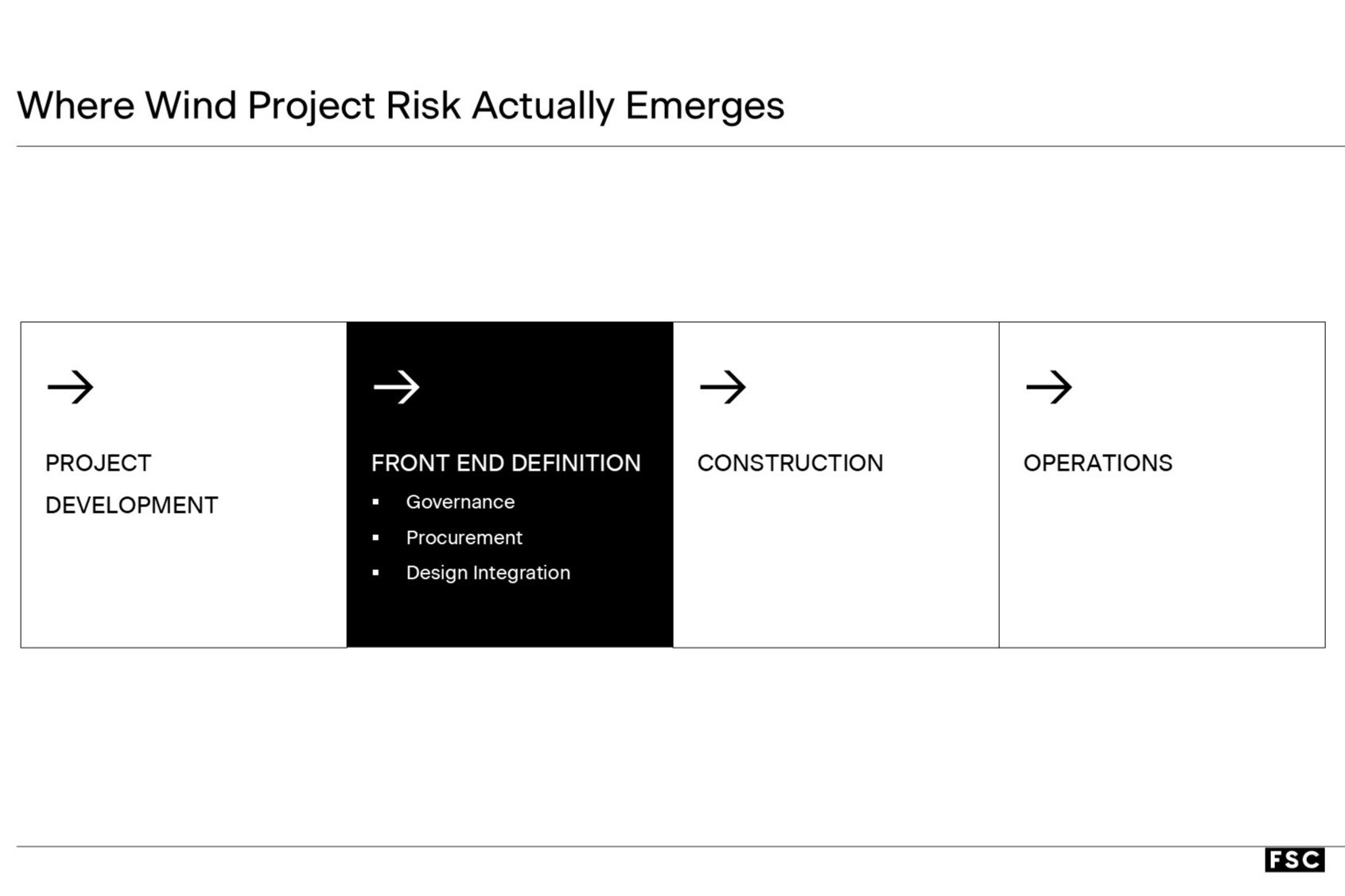
The focus of this support was strengthening front‑end delivery - improving project definition, procurement readiness and coordination between technical streams before the project progressed into detailed design and construction.
Projects of this scale require Owner’s Teams to expand quickly, often bringing together developers, engineers, advisors and contractors with different delivery approaches. Establishing clear governance, integration and program visibility early can significantly reduce delivery risk as the project progresses.
Structuring certainty into the front end
Several practices proved particularly important in strengthening early delivery outcomes.
- Clarifying ownership and accountability
Early in project mobilisation, roles and responsibilities across the Owner’s Team were clearly defined. This reduced ambiguity and enabled faster decision‑making across civil and electrical scopes.
- Reframing the critical path
A review of the procurement program identified electrical balance‑of‑plant infrastructure as a key sequencing driver. By adjusting procurement packages and bringing targeted scopes to market earlier, the project reduced the risk of interface issues emerging later in the program.
- Integrating technical streams early
Early integration between turbine suppliers and balance‑of‑plant designers helped align civil, electrical and transmission assumptions before major procurement commitments were made. This reduced redesign risk and improved cost predictability.
- Building systems for transparency
Project registers covering RFIs, design deliverables, interfaces and procurement schedules were established early. These systems improved visibility across stakeholders and supported disciplined program oversight.
The result: front-end discipline as a value multiplier
Embedding structured governance, procurement strategy and technical coordination into the early phases allowed the project to progress with:
- greater clarity around critical path drivers
- improved alignment between civil and electrical infrastructure
- stronger procurement positioning
- reduced exposure to redesign and delay
Perhaps most importantly, the Owner’s Team gained confidence that the delivery program reflected technical realities and that commercial decisions were being sequenced strategically.